Posts

Showing posts with the label milky way

The Milky Way and the zodiacal light

Image
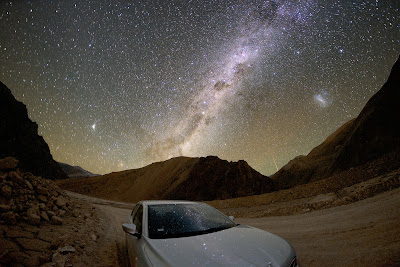
In the southern hemisphere, the central zone of the Milky Way, so elusive at our latitudes, travels very high on the horizon and is able to shine faintly on the ground, creating soft and diffused shadows. In the planet’s remotest places, this is the only source of nocturnal light and this is the reason it seems to shine even brighter, to the point that one has the sensation of being overwhelmed by the immensity of the Universe.  You can see everything in the following photograph, which shows a panoramic view of the Galaxy observed in the uncontaminated Atacama desert sky. That impetuous column of light superimposed over the dense central zones isn’t light pollution or the Galaxy’s light. It’s the zodiacal light: billions of thin and miniscule dust particles roaming in the Solar System are illuminated by the Sun and diffuse a tiny percentage of its light, which can brighten the panorama in the total dark of those uncontaminated places.

The magnificent Milky Way

Image
The grandeur of the summer Milky Way (winter for southern hemisphere) across almost the entire sky can be seen very well in this 30 seconds shot taken from the Atacama desert. The view is similar with the naked eye in a very dark sky, even though the contrasts are not nearly as sharp and our eyes can’t see the real colors which, instead, any camera can emphasize.  There is an impenetrable wall of stars in front of us; this is the only thing that comes to our mind. How is it possible for them to be so compressed together? How can they avoid colliding with each other?  We’re in a place unknown to us and our experience, where space is compressed and makes us see objects as though they were all at the same distance.  The truth is that we are observing a crack tens of thousands of light years deep and objects that emit immense amounts of energy. The result? That on an average that sea of stars has the same density as the place where the Sun is: the stars al...

Millions of stars in the galactic center

Image
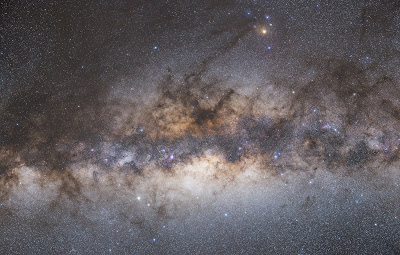
Let’s observe this photo taken from the Atacama desert and try to dream while thinking a bit about what we are seeing. If all of the stars work in the same way, they are all made from the same, extremely common materials, and there are hundreds of billions of them in the Milky Way; so then, the idea could come to mind that our Sun, the planets, the Earth and even life might not be all that rare, because they are all the result of common materials that are joined together, following simple laws of physics by hundreds of billions of times. Why, repeating a single action almost an infinity of times, shouldn’t we expect that a certain result can be repeated again, just as many times?

When the Milky Way lights up the scene

Image
When I was younger and was taking my first steps into the observation of the night sky, I remember very well one of my first astronomical book and especially a chapter where it described the aspect of a perfect sky. A perfect sky is the most normal thing we can imagine: a night sky not contaminated by artificial light. It's the most normal thing because for 4.6 billion of years every living species on Earth saw it and it was normal, just like the rise and set of the Sun, every day. In the last 100 year, the most invasive specie of the Planet was able to destroy the natural beauty of the dark sky for over 80% of the Human population. Now, after 4.6 billion of years, we are the first generation of the entire history of life on Earth that cannot see a perfect night sky. There is just one thing worse than forgetting something important: not having the possibility to do it. We then not only don't see anymore a perfect sky but almost everyone doesn't have memory about that. ...